It is common to hear in the modern media landscape outrageous assertions. A recent post on social media contained an audio clip that claimed Donald Trump Jr. was in favor of delivering weapons to Russia rather than Ukraine. The statement itself immediately caught my attention as one I needed to research, not only because it was controversial, but because it had a few red flags.
Why This Claim Should Have Been Checked
The radicalism of the statement was the first red flag. Misinformation is common, especially towards public figures and those who appear in the media regularly. The second warning was format: the statement had the form of a short, clipped audio piece, without any obvious source or context. Lastly, the article did not refer to a trusted news outlet, and that raised my eyebrows.
Here are the steps I took to investigate this claim:
Step 1: Suspend to Enquire about the Claim
I took time to consider my responses to the claim, whether it made sense or not, and whether it was consistent with what I already knew before. I found it hard to believe that such an assertion would not be reported in the mainstream media, given that it was quite suspicious.
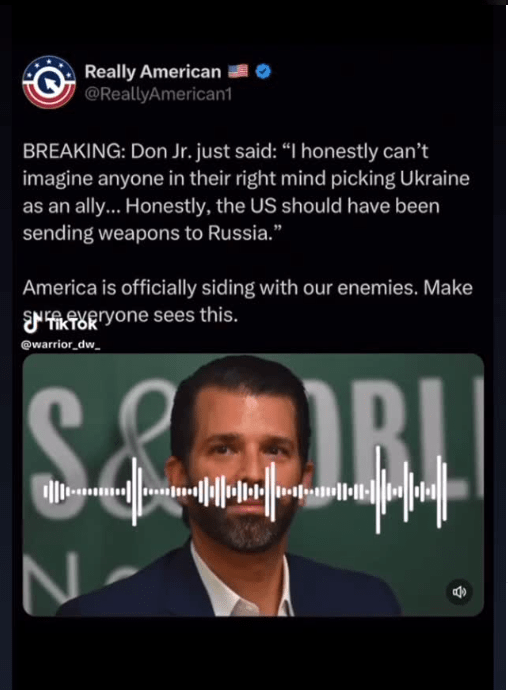
Step 2: Investigate the Source
Then I went to the account that posted the claim. It was neither a confirmed nor popularized source, and its posts contained other sensational or politically provocative material. This was an indication that the account may not be credible.

Step 3: Find Better Coverage
I then tried some keywords based on the assertion, including Donald Trump Jr audio Russia Ukraine fact check. This brought me to an article on FactCheck.org:
The article clarified that the audio-video being spread on the Internet was not a genuine one. It was digitally altered, probably with an AI or editing method, to sound like an actual statement.
Step 4: Track the Claim to its Source
The fact-checking article has also pointed out that the clip had no verifiable source. No complete recording, speech, or interview where this statement was found. This is a big red flag. Verbatim quotes by high-profile personalities are typically attributed to a given incident or documentation.
The article further elaborated that no reputable news agencies had reported such a statement, which proved the audio was a fabrication.

Step 5: Evaluate the Evidence
Here I contrasted the evidence:
- This initial assertion was made by a not-so-trusted source.
- The sound was of no ascertainable source.
- It had been disproved by a reputable fact-checking organization.
- There was no reliable news media that could verify the claim.
Every piece of evidence indicated that the statement was fallacious.
Final Evaluation
The claim, after this process, proved to be false. The audio clip is also not genuine and was probably doctored to disseminate false information. This illustrates the ease with which misleading but easily convincing material can spread on the internet.
False claims can be avoided by taking a few minutes to check out information and keep others informed. We can become more responsible information consumers by following a few simple steps, such as checking the source, seeking out coverage we can trust, and questioning what we read and hear.
Critical thinking and verification are critical skills in a world where misinformation is easy to spread. When something sounds convincing, then it is always worth having a closer look.


 MCO 427
Leave a comment